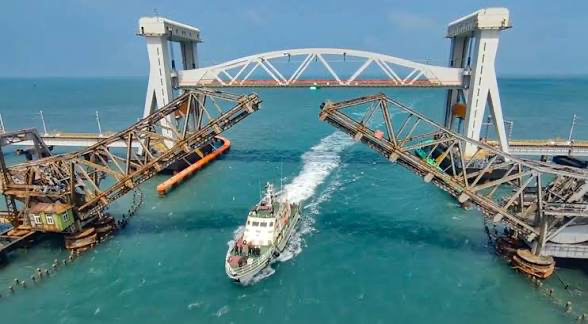
Pamban Bridge (Tamil: [paːmbɐn], romanised: pāmban) was a railway bridge that connected the town of Rameswaram on Pamban Island to Mandapam on mainland India. Opened on 24 February 1914, it was India’s first sea bridge, and was the longest sea bridge in India until the opening of the Bandra–Worli Sea Link in 2010. It was a conventional bridge resting on concrete piers with a double-leaf bascule section midway, which could be raised to let ships and barges pass through.
Pamban Bridge | |
|---|---|
 A train on the Pamban bridge in 2016 | |
| Coordinates | 9°16′57.25″N79°12′5.91″E |
| Carries | Rail |
| Locale | Rameswaram, Tamil Nadu, India |
| Owner | Indian Railways |
| Characteristics | |
| Total length | 2,065 metres (6,775 ft) |
| No. of spans | 144 |
| Rail characteristics | |
| No. of tracks | 1 |
| Track gauge | Broad gauge |
| Electrified | Rigid Overhead Catenary System |
| History | |
| Construction start | August 1911 |
| Construction end | February 1914 |
| Opened | 24 February 1914 |
| Closed | 23 December 2022 |
| Replaced by | New Pamban Bridge |
| Statistics | |
| Daily traffic | Suspended |
| Location | |
 Interactive map of Pamban Bridge | |
The Pamban bridge was the only surface transport link that connected Rameswaram to the mainland India until 1988, when a road bridge was constructed parallel to the railway bridge. In 2020, construction of a new bridge closer to the existing one began which was planned to eventually replace the existing bridge. In Dece
Click one of our contacts below to chat on WhatsApp